

The federal Safe Streets for All (SS4A) program is set to expire in about a year. It delivered billions of dollars to projects across the United States based mostly on safety criteria. In the last round of grants, Colorado and Vermont were the only two states to receive zero dollars ($0) in awards. That included Boulder County’s application for around $21M to build the North Foothills Safety Project from the City of Boulder to Neva Road in or near the US 36 North Foothills Highway right-of-way.
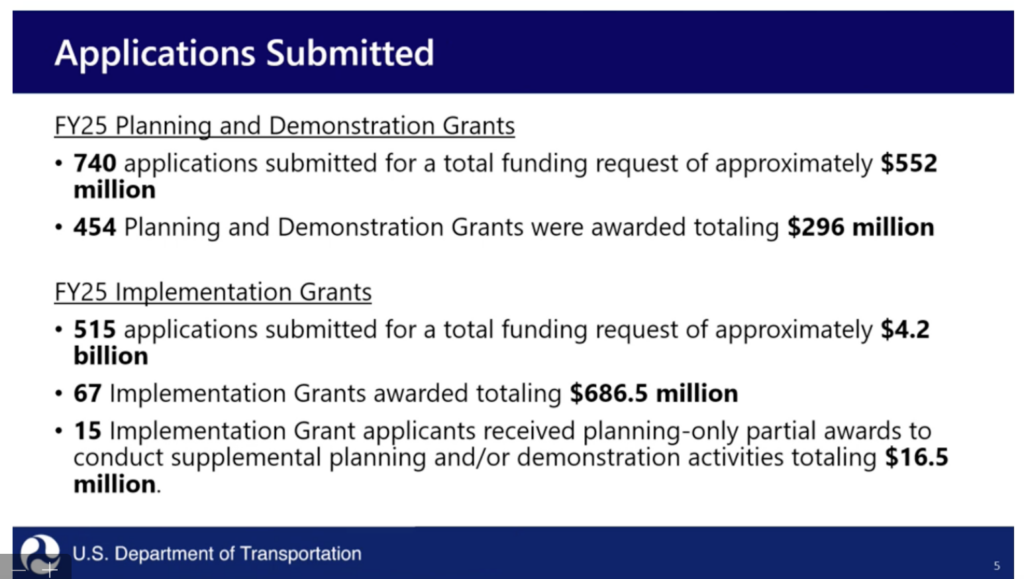
A summary outline of SS4A funding. One can see that the program is vastly oversubscribed. This is a basic truth in transportation, there’s not enough money in the first place.
As a result of all of this, C4C has had to go back to the drawing board in order to identify and then act upon how it delivers value to its supporters. Here’s C4C’s answer.
C4C’s Focus: Stay The Course on The North Foothills Highway Safety Project
Along with the original partners who committed to fund the required 20% local match of about $6M in order to qualify for the above $21M grant, C4C is partnering to attempt to apply for the same or similar grants again. The intention is to stay the course and to get the North Foothills Safety Project into construction on a phased basis. In order to do this, C4C must continue to raise money to put towards the local match.
Last time, in order to meet the matching requirement for $21M, Boulder County promised about $3M+, CDOT $1M, The Governor’s Office $1M, The City of Boulder $100,000, and C4C $58,400. This time, C4C is aiming for $100,000.
Ongoing Work at C4C
C4C maintains a mix of projects that flow from guiding principles. Primary among those principles is that Boulder County’s Transportation Master Plan is a role-model plan. The task is to support staff to execute it. Here’s a summary of what you support when you support C4C.
Vision Zero (Safety) Interventions
Maybe abstract to the observer, one of the most important roles that C4C plays is supporting staff in Boulder County. Boulder County Transportation is executing on leading standards. Nowhere does that happen more than in its basic approach to safety which is two-pronged. One, evidence based interventions where the data indicates the need. Two, design standards that create mobility, safety, comfort, and great lives in the first place. That means that Boulder County is leading nationally on its Vision Zero Action Plan. It takes a data based approach and fixes those locations on an urgent basis. Parallel to this, it builds role-model projects like the Colorado 119 Project. When you support C4C, you support C4C’s capacity to support Boulder County to deliver on excellence in transportation.
All that is turning into funding and execution, see here.
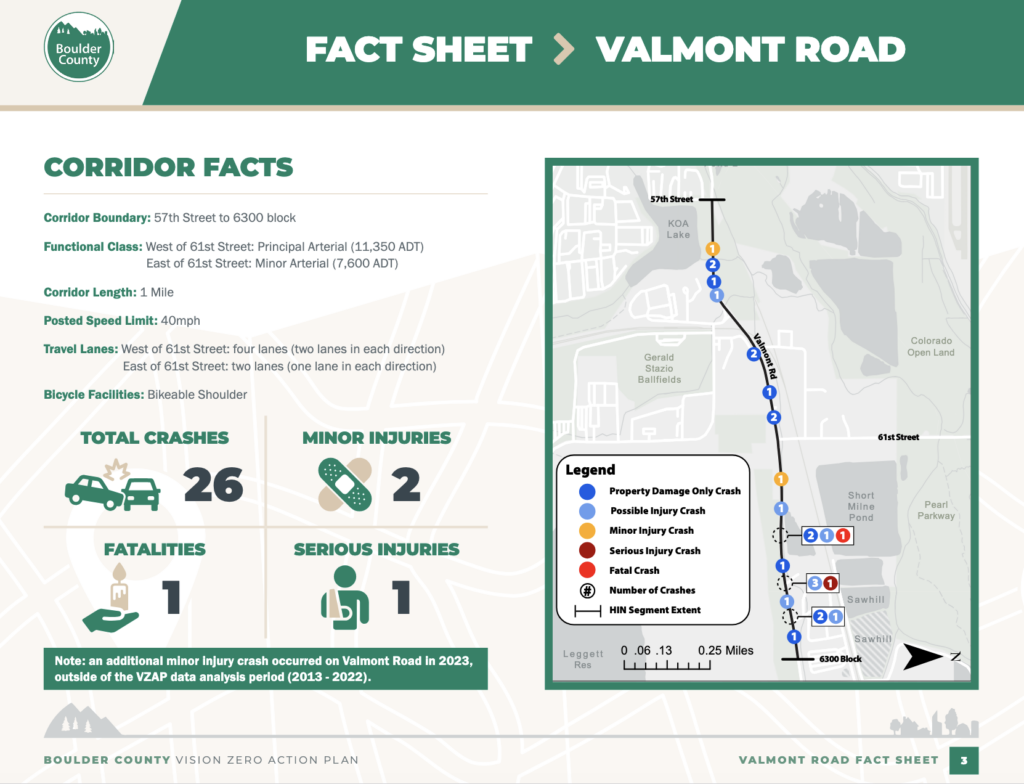
Boulder County has indicated that it is hopeful about funding for the projects listed in Appendix D in the Vision Zero Action Plan. That means good plans with good design that are getting built.
US 36 near Davison Mesa, just southeast of the City of Boulder, has seen sufficient roadway departures (autos crashing off the roadway) that Boulder County is seeking funds to put barriers in the area between the roadway and the bikeway. Thanks to Ride Broomfield for leading on this project too.
Several folks asked me (Matt Muir) to take a look at this, https://coalition4cyclists.org/comment-on-the-town-of-superior-88th-street-project/. I did and as the post states, it is a problem, and others are doing a good job of working on it.
Long Term Project Monitoring
Colorado 7 / Arapahoe is in a major planning and design phase. C4C has participated so far and focused on maintaining a separated bike-ped facility along the length of the project, at least in Boulder County. So far, that is the plan and the bike-ped path will vary a little based on location.
US 287 is the county’s most dangerous road for drivers. Accordingly, it is getting urgent funding to build design adaptations that protect drivers. C4C is monitoring this and reminding the agencies involved that the county’s TMP calls for a separated bikeway along US 287. Travel in that area won’t be truly safe until the bikeway is also built.
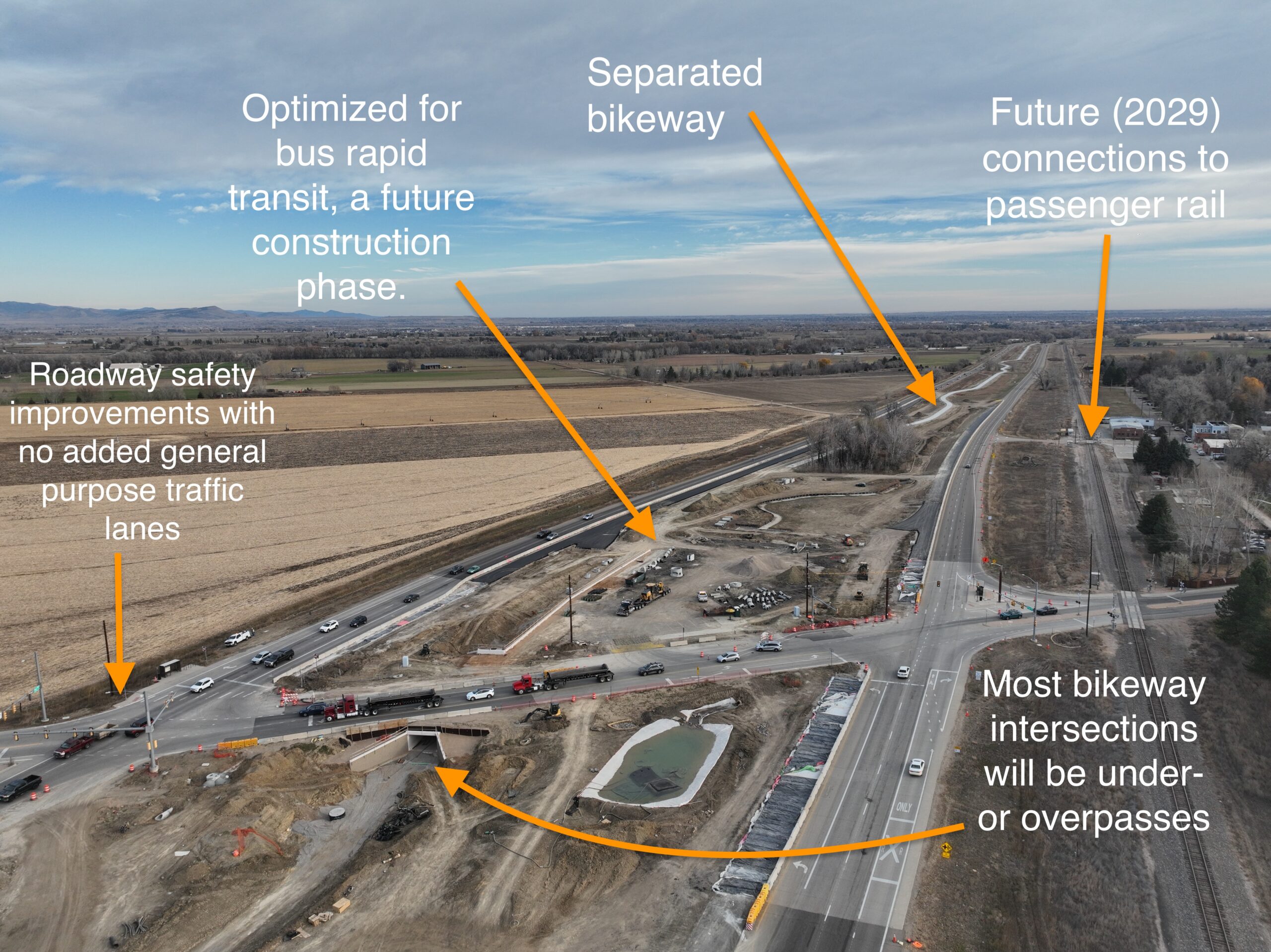
Colorado 119(B) Boulder – Longmont is scheduled to be complete in spring 2027. It’s a role-model project on a national level. C4C, like a broken record, is advocating that this project should be adapted and scaled across Colorado’s diverse transportation environment. It’s what the future should look like. No added general purpose travel lanes, evidence based roadway safety improvements, optimized for bus-rapid-transit with dedicated lane space, a separated bike-ped facility with grade separation, future connections to rail, and all of it connected at a network scale to everything around it. Its design produces mobility, safety, and comfort for all.
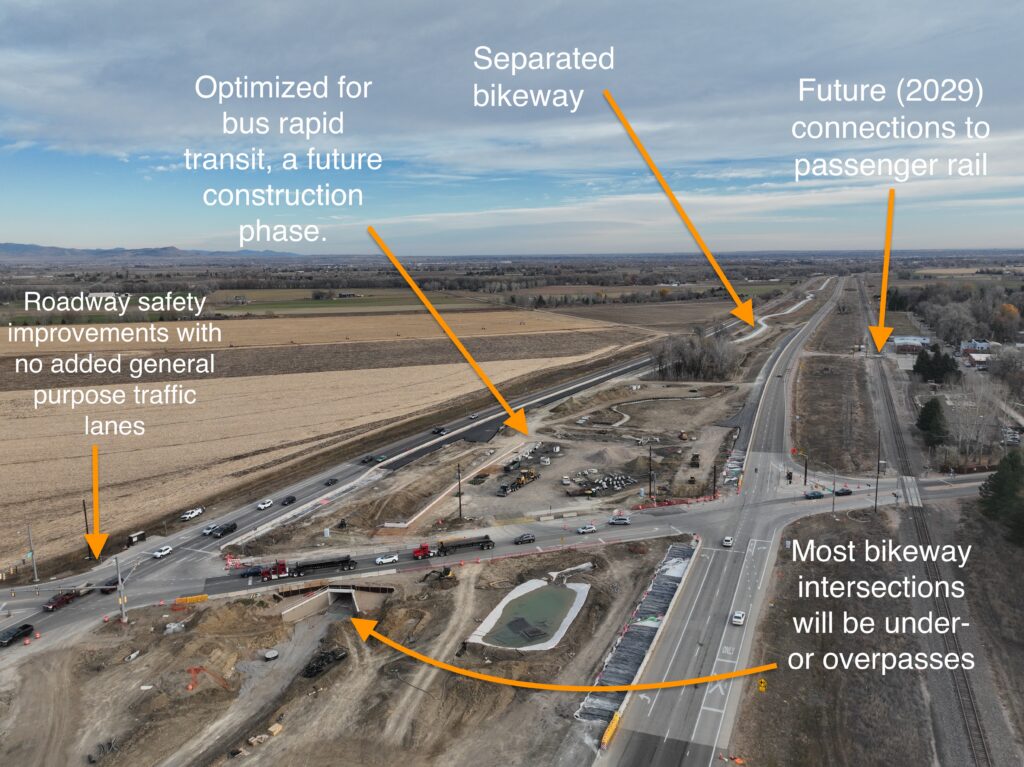
The Diagonal 119(B) Project is scheduled for completion in spring 2027. It’s a model for how to design right-of-way for lots of different travel modes and how to connect them at a network scale.
There are some plans way out on the horizon that C4C watches. Highway 66 Longmont – Lyons, Highway 52, US 287 north and south beyond the county’s boundaries, and other minor plans.
Build The Network at All Its Levels
Boulder County is methodically marching is Regional Soft Surface Trails forward as well. C4C supports this work. This consists of building the missing parts of the LoBo Trail, building the BERT Trail, and then designing and building the St. Vrain Greenway Trail. These are examples of great planning matched by paced funding. It’s great work.
C4C keeps an eye on things like bike-able shoulders, in Boulder County this is easy to do. The county is serious about its transportation standards and maintaining or improving bike-able shoulders on county roads is something it does well.
C4C has been pleased to support the BMA’s work and specifically the so-called South Sky proposal. C4C and the BMA are aligned on this project and its principles. If you give people access from home, then they can start their ride at their door, avoid the safety risks of riding on roadways, and it manages the self-perpetuating need to keep building more trailhead parking. C4C has been lending political support to this proposal.
The Intersection with State Level Work
CDOT’s construction budget is called The CDOT 10-Year Plan. C4C has monitored this, mostly in an effort to keep funding for C4C’s main focus, The North Foothills Safety Project, in the 10-Year Plan.
I have a bone to pick with the 10-Year Plan starting with that it’s not a plan, it’s a list of construction projects that come from disorganized and contradictory interests with no connection to a plan or vision. It does keep the money flowing. In a perfect world, I’d tie the 10-Year Plan to the Colorado Transportation Vision 2035 which is a vision without a plan or a budget. If they were connected, it would be a vision tied to a plan tied to a budget which is how great things get done.
Law Enforcement
C4C maintains a line of communication with the Boulder County Sheriff’s Office. We’re really grateful to them for their thoughtful enforcement of the laws intended to protect all of us. C4C has a board member who has worked with the BCSO for years and we leave this relationship to that board member. It’s also not all roses, over the years the BCSO has called me (Matt) on the phone to discuss some frustrations they are having. I am more than pleased to listen considering the importance of their role.
Longshots and Difficult Projects
For years, I (Matt) have tried and failed to propose a hard surface bikeway between Golden and Boulder along or in the Colorado 93 right-of-way. There are lots of reasons this is not a great idea. And, its connectivity potential, its shared funding potential spread among two counties and three cities, and its design potential with rail and bus and bike-ped all together are reasons it would be worthwhile.
CDOT is redoing its Active Transportation Plan which got tied up in SB25-030. To the point of annoyance, I’ve been communicating to CDOT that the ATP should show a vision for a statewide bike network to engineering standards and that’s comfortable for most users. Bike-able shoulders are not comfortable and the engineering, crash, and high-injury network data show that they are not safe. Utah has a vision for a statewide path network. Utah’s got the right idea.
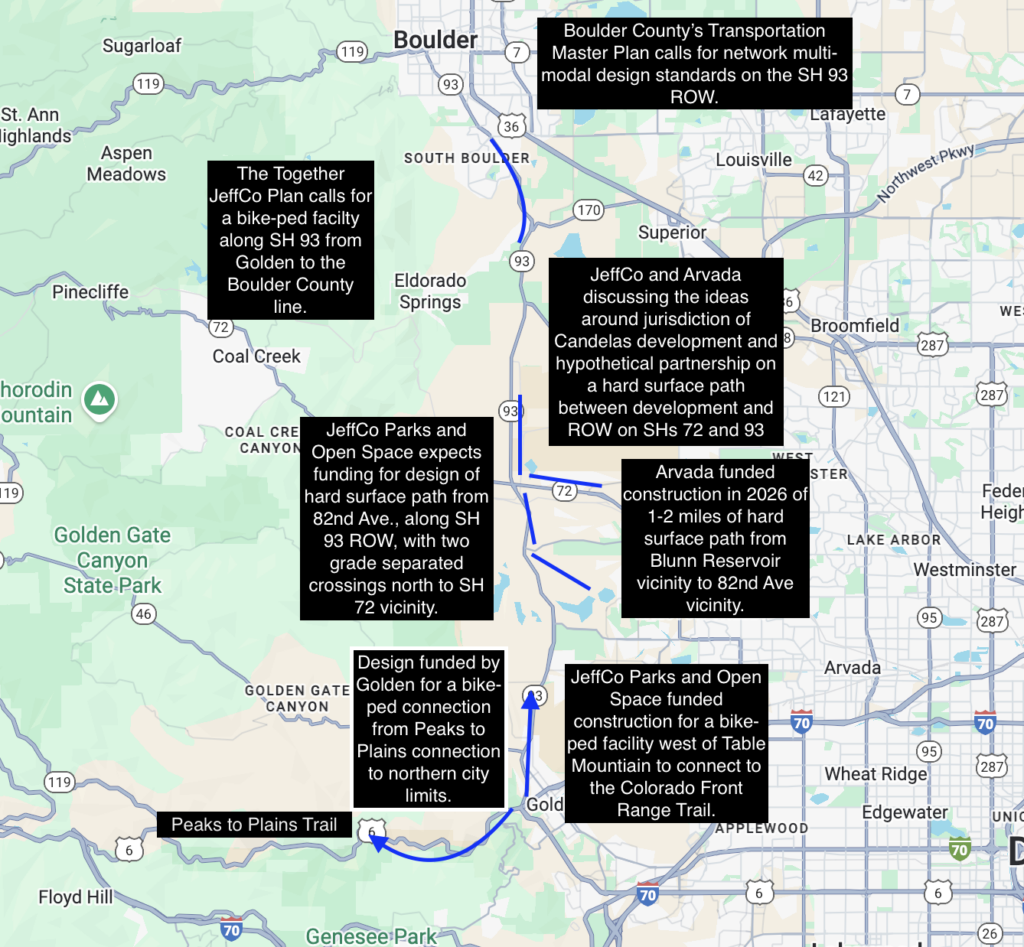
Illustrative of the numerous layers of government in the U.S., all these projects are happening and there’s no real incentive to coordinate them at a broader level to satisfy desired outcomes like connectivity.
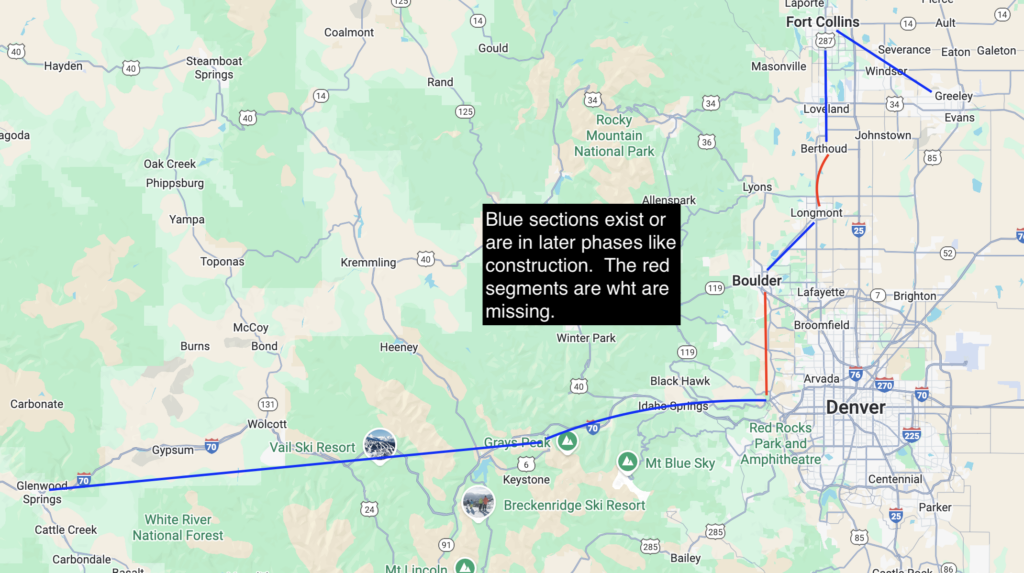
Rudimentary to be sure, this map, nonetheless, shows how Colorado 93 is a crucial connection to larger bikeway/path work on a statewide scale. At $500,000,000 to build, the Clear Creek Trail is great…if you can get to it.
Legislation
With infrastructure and infrastructure funding maxed-out, C4C is for the first time turning more attention to legislation and how policy can improve safety. C4C works closely with Bicycle Colorado on these topics and it takes time to establish consensus.
For the first time, C4C has a second and its first ever full-time employee. That is slowly creating more time for me to work on legislation.
Technology
Technology plays a role in transportation and safety outcomes. The White Line Foundation has done a nice and persistent job on automatic braking systems at the federal level. Technologies like Waymo are producing autos that are far more safe then human driven autos in most cases. C4C has participated minimally in supporting https://spokesafety.com/ partly because it can be partially retrofitted into most cars made after 2016 or so.
The problem with technologies like these, as transportation experts point out, is adoption or saturation, that is, how long it takes for millions of autos to use the technology. Every little bit helps is my position and that’s why I’ll help technology where I can.
Thanks for supporting C4C and great and safe cycling in Boulder County,
Matt Muir, Policy Director